What Leaves the Building: Sizing Up Refuse Before a UK Office Lease
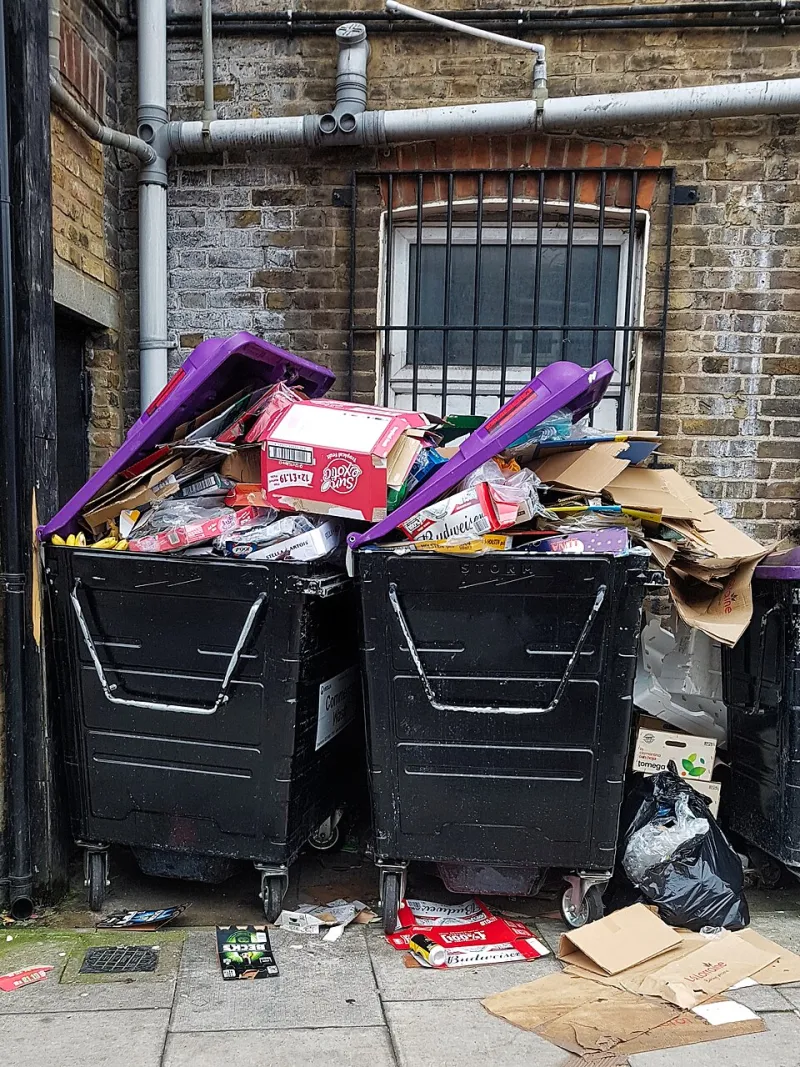
Photo: Acabashi, CC BY-SA 4.0, via Wikimedia Commons
Refuse is the least glamorous line in any office occupation and one of the most reliable sources of friction. A small team can sign a lease, move in, and discover that the bin store holds four wheeled bins for a building of sixty people, that collections happen at 06:30 on a Monday, and that the cardboard from the fit-out is nobody's responsibility. The questions below are worth asking at viewing stage, when the answers still influence the decision.
The bin store is a room with a contract attached
Treat the bin store as a piece of demised or shared space with its own operational terms. Is it inside the demise or in a shared yard? Is it locked, lit, ventilated and drained? Can a 1100-litre bin be wheeled out without lifting it over a kerb? The answers determine whether your facilities arrangements are a small administrative task or a daily physical one.
Calculating what the team actually throws away
A rough planning figure for a typical office is 1–2 kg of mixed waste per person per day, of which a significant share is recyclable. A twenty-person team therefore generates something in the region of 20–40 kg a day, or 100–200 kg across a working week. That is a starting point, not a specification: a firm with a kitchen, a print room or regular deliveries will exceed it.
Translate the figure into containers. A 240-litre wheeled bin, a 660-litre bin and a 1100-litre bin are the common sizes, and collection contracts are usually priced by container and frequency. Ask the landlord or managing agent what capacity is allocated to your suite, how often it is collected, and whether the allocation is fixed or shared on a first-come basis. A shared bin store with no allocation is a dispute waiting to happen.
Duty of care, transfer notes and the recycling rules
Every business in the UK has a duty of care for the waste it produces under the Environmental Protection Act 1990. That means using a registered waste carrier, keeping waste transfer notes, and being able to show where the material went. In England, the Simpler Recycling reforms require businesses to separate dry recyclables and food waste; the food waste obligation applies to businesses with ten or more employees. Rules in Scotland, Wales and Northern Ireland differ, so a multi-site occupier should not assume a single template.
Ask who holds the waste carrier registration, whose name is on the transfer notes, and whether the contract sits with the landlord, the managing agent or the tenant. In a multi-let building the answer is often 'the service charge', which brings its own questions about apportionment and transparency.
The refuse vehicle test
Collection is a logistics problem before it is an environmental one. Refuse vehicles need turning space and a safe stopping point. Bins may need to be dragged ten, twenty or thirty metres to the kerb, and some operators impose a maximum drag distance in their contracts. Check collection windows against your opening hours: a 06:00 collection in a residential street may be the only slot available, and it may also be the reason the neighbours complain.
In dense city centres, timed collection and permitted streets add a further layer. A building on a red route or in a conservation area may have restricted hours, and a bin store that opens directly onto the pavement raises its own questions about obstructions.
Odour, pests and the warm corner of the building
Look at where the bin store sits relative to windows, air intakes and the kitchen. A store with no shade, no drain and no wash-down point will smell in July and attract pests year-round. Ask whether pest control is included in the service charge, how often the store is cleaned, and who repairs damaged lids and broken wheels. These are small items individually and a recurring cost collectively.
Bulky waste and the fit-out hangover
Fit-outs generate pallets, packaging, old furniture and redundant IT. Most leases put the removal obligation on the tenant, and most service charge regimes exclude it. Establish before signature who will remove bulky items, at what cost, and whether the landlord's contractor must be used. A separate licensed collection is often cheaper than an ad hoc arrangement, but it needs booking.
Leased, serviced and co-working: where the waste sits
In a conventional lease, the tenant usually holds the waste contract and pays the rates. In a serviced office, waste is bundled, but the bundle is rarely itemised: ask what happens when the team exceeds the fair-use allowance, and whether confidential waste or food waste is included. In co-working, the shared bins are generous until they are not, and licensing terms often prohibit certain categories altogether.
The questions to put before signature
What capacity is allocated to the suite? How often is it collected, by whom, and at what time? Is the contract in the service charge, and how is it apportioned? Who holds the carrier registration and the transfer notes? What recycling separation is required, and who pays for extra collections? Where is bulky waste removed to, and by whom? Who cleans and repairs the bin store?
None of these questions will make or break a lease on its own. Together they decide whether waste is a background service or a recurring argument, and that is worth ten minutes at the viewing.