Ten Minutes on Foot: How Everyday Amenities Should Score a UK Office Viewing
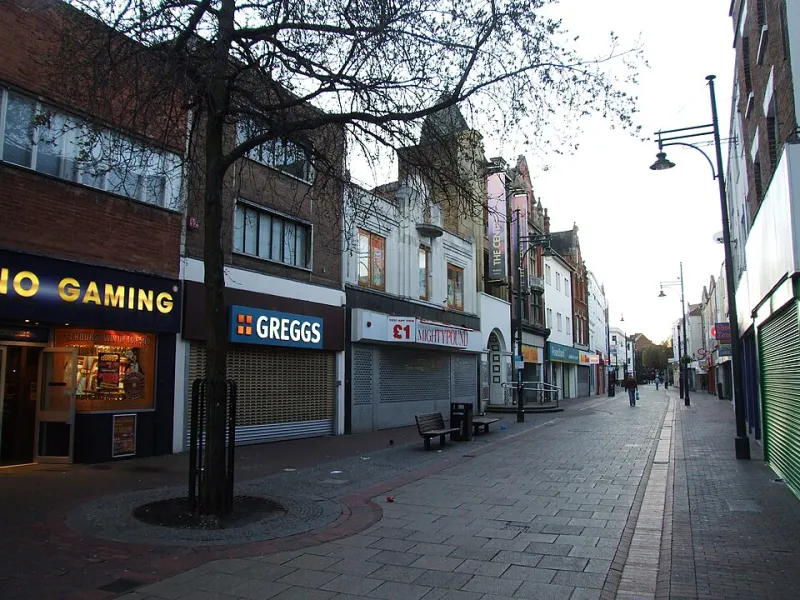
Photo: Chris Whippet , CC BY-SA 2.0, via Wikimedia Commons
Estate agents will tell you about the station. They will rarely tell you that the nearest sandwich shop closed in 2024, that the only pharmacy is a fifteen-minute walk, or that the 'vibrant quarter' is vibrant between 6pm and 11pm and hollowed out at midday.
The immediate neighbourhood is a workplace amenity whether or not it appears in the lease. Staff use it daily; clients judge it on arrival. Ten minutes on foot is the right unit of measurement, because that is roughly how long anyone will actually spend walking to fetch food before a 2pm meeting.
Why the lunch radius earns a score
Retention is expensive and hiring is slow. A dull address with no food options becomes a reason people quietly drift towards hybrid working, and a reason a candidate picks the other offer. Meanwhile, client-facing firms discover that entertaining in a business park means driving somewhere, which changes how often anyone bothers.
Scoring the walk forces a discipline that a viewing does not. It converts a vague impression into a number you can compare against other buildings, and it makes the trade-offs visible.
The six categories
Award 0 to 5 in each.
Everyday food (weight 3). A convenience store, a supermarket within reach, a bakery or sandwich shop, and at least one place to sit down. Not a chain-versus-independent judgement — just how many decent options exist at 12:30 on a weekday.
Caffeine and informal meetings (weight 2). Somewhere to take a candidate or a supplier without booking. Two or three options score well; a single Costa three streets away scores politely.
Client-grade lunching (weight 2). If your business hosts clients, is there anywhere within ten minutes that is good enough for that? A decent restaurant, a hotel lounge, a private dining room. Firms that never entertain can score this as neutral rather than zero.
Practical services (weight 2). Pharmacy, post office, a bank branch or cash facility, a dry cleaner, a dentist or GP within a reasonable walk. These are the quiet determinants of whether a location works for a full week.
Green space and breathing room (weight 2). A park, a square, a riverside path. Somewhere to take a call, eat outside or clear your head. In dense city centres this matters more than the floor plan suggests.
Getting away (weight 1). Bus stops, a station, taxi rank, cycle parking, and whether the immediate streets are walkable after dark.
A worked example
Take a mid-market suburban office block. Everyday food: one convenience store, no supermarket, no sit-down lunch — score 2. Caffeine: one café that closes at 3pm — score 1. Client-grade: nothing — score 0. Practical services: pharmacy and post office half a mile away — score 3. Green space: a recreation ground at the end of the road — score 3. Getting away: two bus routes, no station — score 2.
Weighted up, that is a modest score with a clear weak point: client hosting. If your business runs on client meetings, the building fails on a category that no amount of parking will fix.
Run the 12:30 Tuesday test
Viewings happen at 10am on a Thursday, when everything looks reasonable. Go back at half past twelve on a weekday and walk the radius in the clothes you would actually wear to work. Count the people. Are the cafés full or shuttered? Is there a queue at the sandwich counter? Is the high street actually a dual carriageway with a footbridge?
Do it in the rain, too, if you can. A ten-minute walk becomes a twenty-minute ordeal in February, and that is when you find out how good the covered routes are.
When quiet is a problem in disguise
A quiet street can be a genuine asset. But check what sits behind the quiet.
- The single-use estate. An office cluster with no residential mix often has no food provision at all, because there are not enough evening customers to sustain it.
- The ring-road address. Looks central on a map, is severed by a dual carriageway in practice. Measure the actual walking route, not the straight-line distance.
- The regeneration promise. A hoarding advertising units 'coming soon' is not a sandwich shop. Ask what has opened in the last two years, not what is planned.
- The evening economy only. A leisure quarter with bars and restaurants may have almost nothing open at lunchtime, and noise after 11pm is its own problem.
- The delivery dependency. If the only realistic option is a delivery app, factor in the cost per head per day and the reliability at peak times.
Practicalities that never make the brochure
Loading bays and delivery windows matter if you receive stock. Cycle parking matters if anyone rides in. Cash points and parcel lockers matter more than most occupiers admit until week two. And a quiet word with staff in a neighbouring business about parking enforcement will tell you more than the agent will.
Recording the score
Keep a simple sheet — six categories, a weight, a one-line note and a photograph of each stretch of street. Score three buildings the same way, on the same day of the week, and the decision usually becomes obvious. The building with the better floor plan may lose to the one where people can actually buy lunch, and that is not an irrational result.
The lunch radius is not a substitute for reading the lease or auditing the building services. It is simply the part of the due diligence that tells you whether the address will be liked on a wet Tuesday in February, which is when opinions about an office are really formed.