The Kettle as a Compass: Auditing a UK Office Kitchen Before You Commit
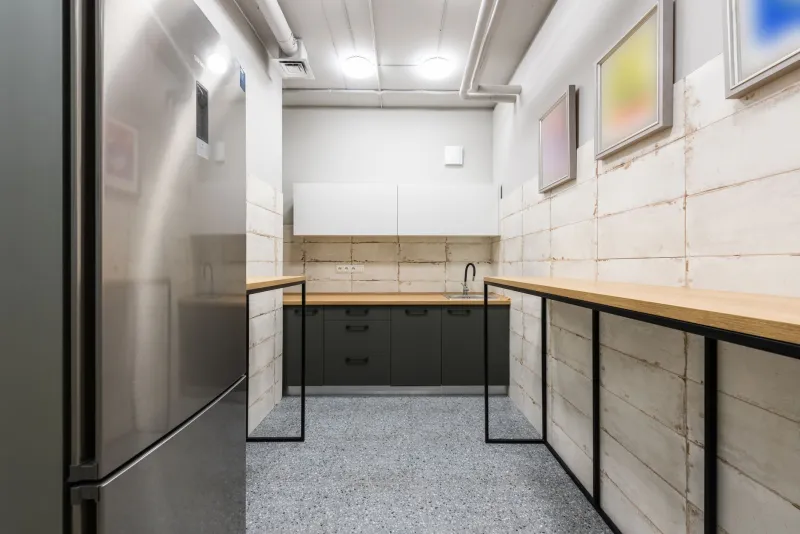
For a small UK business comparing offices, the kitchen is often treated as a footnote. It is a small space, usually windowless, frequently shared and rarely the reason a lease is signed. Yet the tea point is where building services, management culture and daily routines meet. A hybrid team may use desks intermittently, but the kitchen is often a genuine reason to come in: a place for the informal conversation that a video call cannot replicate. During a viewing, ten minutes in the kitchen can reveal more about how a building works than a polished reception area.
Begin at the tap
Turn on the cold tap and watch the pressure. Fill a kettle and time it. Run the hot tap and see how long it takes to reach a usable temperature. Check that the sink drains without gurgling or pooling. These small tests expose plumbing and maintenance standards that may not appear in the particulars.
Ask who is responsible for repairs. In a leased floor, the tenant may carry the obligation for internal plumbing; in a managed or flexible building, the operator may retain it. Either way, clarify the reporting route and response time. Look under the sink for signs of leaks, accessible isolation valves and a stopcock that can be reached without moving cupboards. In shared kitchens, ask whether water hygiene checks are coordinated by the landlord or occupier, and request the relevant records for the building.
Air, extraction and the smell test
A kitchen without effective extraction will broadcast every lunch. Check for an extractor hood, grease filters and a route for odours to leave the space. In sealed, air-conditioned buildings, ask how ventilation serves the kitchen and whether extraction continues outside standard hours. Condensation, damp patches and lingering cooking smells are practical signals, not merely cosmetic ones.
This matters beyond the kitchen. If the tea point sits next to meeting rooms or quiet work areas, poor ventilation will make the whole floor less pleasant. Ask whether the building has a cleaning and maintenance programme for extract filters, and whether that cost sits within the service charge.
Capacity, not just appearance
A kitchen can look generous and still fail a busy team. Count the available fridge shelves against the likely number of regular occupants. Hybrid working can create sharp peaks: a Tuesday or Wednesday may feel far busier than the nominal desk count suggests. Check dishwasher capacity and cycle time, and ask who empties it. Look at cupboard space, lockable storage and whether there is a practical way to separate allergens.
Waste is part of the same equation. Are there adequate recycling and general waste bins? How often are they collected? Who arranges the contract? Check the number of kettles, boiling taps, microwaves and toasters, and consider the queue at the traditional mid-morning break. A single microwave in a building with forty regular attendees is a bottleneck, however attractive the worktop.
Cleaning and the boundaries of responsibility
Most kitchen disputes are not about appliances. They are about boundaries. Ask for the cleaning schedule and the occupier handbook. In a multi-let building, communal kitchen cleaning may be covered by the service charge; on a leased floor, the tenant may be responsible. Shared kitchens need clear rules on bins, dishwashers and fridge clear-outs. Who removes out-of-date food? Who cleans the filter? Who restocks supplies?
Look at the condition of the space, but interpret it carefully. A sticky worktop on viewing day is not proof of systemic failure, but repeated limescale, overflowing bins and neglected appliance seals are worth questioning. Ask for recent service-charge budgets and reconciliations where communal cleaning is recovered. The answer will tell you whether the kitchen is actively managed or merely provided.
Service-charge surprises
The kitchen can hide costs. Communal water, drainage, cleaning, waste collection, pest control and maintenance contracts may all be recovered through the service charge. Ask whether the kitchen falls within the demised area or the common parts. In flexible workspace, check what the inclusive rate actually covers and whether fair-use caps apply to printing, hospitality or consumables.
For leased space, review the schedule of condition and consider dilapidations. Extractor cleaning, appliance removal and making good at the end of the term can all carry a cost. Ask for the service-charge apportionment and any cap on recoverable costs. In 2026, with energy and waste costs under close scrutiny, request the current budget rather than relying on a previous estimate. Compare the total occupation cost across shortlisted buildings, not just the headline rent.
Inclusion, acoustics and the social function
Check accessibility. Is the worktop at a comfortable height? Is there knee clearance for a wheelchair user? Can the tap and microwave be reached safely? Is the route step-free? These details affect whether the kitchen is genuinely usable by the whole team.
Listen to the room. Hard surfaces amplify noise, and a kitchen placed beside quiet desks can become a source of friction. Ask about usage hours and after-hours access. A tea point that doubles as an informal meeting room can be an asset for a hybrid team, but only if the acoustics and layout allow it. Security matters too: fob access, visitor arrangements and whether the kitchen is shared with other tenants.
Leased, managed and flexible: different questions
In a leased office, focus on fit-out responsibility, water and waste contracts, cleaning, extraction maintenance and end-of-term obligations. In a managed building, ask for service levels, shared-kitchen rules and the escalation route when something fails. In a flexible workspace, request the member handbook and confirm guest access, consumables and fair-use policies. The same room can carry very different obligations depending on the occupation model.
A short viewing checklist
- Test tap pressure, hot water delivery and drainage.
- Check extraction, condensation and cooking smells.
- Count fridge shelves, microwave points and dishwasher capacity against likely peak occupancy.
- Confirm waste and recycling arrangements.
- Obtain the cleaning schedule and responsibility matrix.
- Identify kitchen costs within the service charge or inclusive rate.
- Assess accessibility, acoustics and after-hours access.
- Review dilapidations and make-good obligations before signing.
The kitchen is not a trivial detail. It is an operational stress test. If the tea point works, a hybrid team has one more reason to gather, collaborate and stay. If it fails, staff will vote with their feet and the office will feel emptier than the desk count suggests. At Domain Office Search, we treat the kitchen as part of the comparison, not an afterthought.